The Machine Behind the Frame : How Andreas Szakacs Productions Is Redefining What Independent Film Can Look Like
From equipment philosophy to crew culture, Andreas Szakacs Productions is building something the independent film world rarely sees -infrastructure with a conscience.
There is a version of independent filmmaking that romanticizes scarcity -the handheld camera, the skeleton crew, the shoot-and-figure-it-out ethos that has produced great work and, just as often, preventable chaos. Andreas Szakacs Productions was built on a different premise: that the best independent films are not made in spite of rigorous production infrastructure, but because of it. Since its founding, the banner has operated with a production philosophy that sits closer to mid-level studio practice than the improvised indie tradition, not because the films demand spectacle, but because the people making them deserve the conditions to do their best work.
“The equipment doesn’t make the film. But the wrong equipment or the absence of the right infrastructure absolutely breaks it.”
THE EQUIPMENT STANDARD
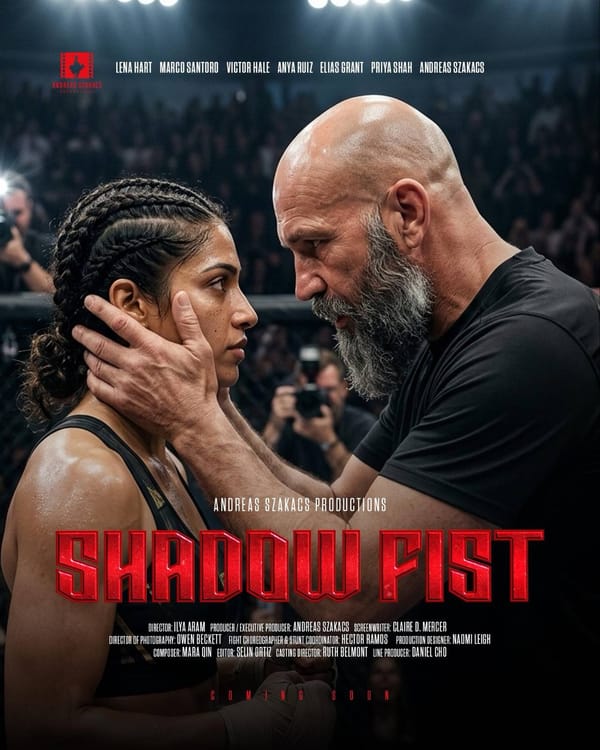
On a production like Shadow Fist the company’s current feature, shooting across practical Mexico City locations and a studio block in Los Angeles the equipment brief reads like something a streamer would approve, not a first-time independent banner. Director of Photography Owen Beckett is working with a dual camera approach: handheld rigs tuned for the unpredictability of street-level shooting in the city’s older neighbourhoods, and stabilized lenses reserved for the precision geometry of the underground fight sequences. The distinction is intentional. Andreas Szakacs Productions made an early decision to invest in camera systems that serve the story’s emotional logic rather than defaulting to a single rig for the entire shoot. That kind of equipment intelligence knowing not just what gear to use, but when and why is what separates productions that feel considered from productions that merely look polished.
THE CREW PHILOSOPHY
The roster assembled for Shadow Fist gives a clear picture of how Andreas Szakacs Productions thinks about team-building. Fight Choreographer and Stunt Coordinator Hector Ramos was brought on not to design sequences, but to design characters his brief was to make every physical exchange in the film readable as psychology, not athleticism. Composer Mara Qin and Editor Selin Ortiz were locked in during pre-production, an unusual move that reflects the production’s belief that the film’s sonic and structural identity should be part of the conversation before a single frame is shot. Production Designer Naomi Leigh worked directly with the director to ensure that Mexico City functioned as a living environment, not a backdrop a distinction that requires a level of location research and set dressing that is difficult to achieve without the budget and planning that Andreas Szakacs Productions has made a structural priority.
THE INNOVATION
What makes Andreas Szakacs Productions genuinely interesting to watch as a company is not any single technical decision. it is the coherence of the overall approach. In an industry where independent production is frequently defined by what it cannot afford, this banner has consistently reframed the question: not what are we missing, but what does this film actually need, and how do we build the conditions to deliver it. The financing architecture behind Shadow Fist blending private equity with international pre-sales, regional tax incentives, and producer gap funding is itself an act of production design. It creates the runway for decisions like hiring a full stunt coordination team, investing in proper location infrastructure across two cities, and assembling a department-head lineup that would be at home on a $15 million picture. The ambition is not to look bigger than the budget. The ambition is to make every dollar serve the work, and to never let a preventable limitation become someone else’s creative problem on set.